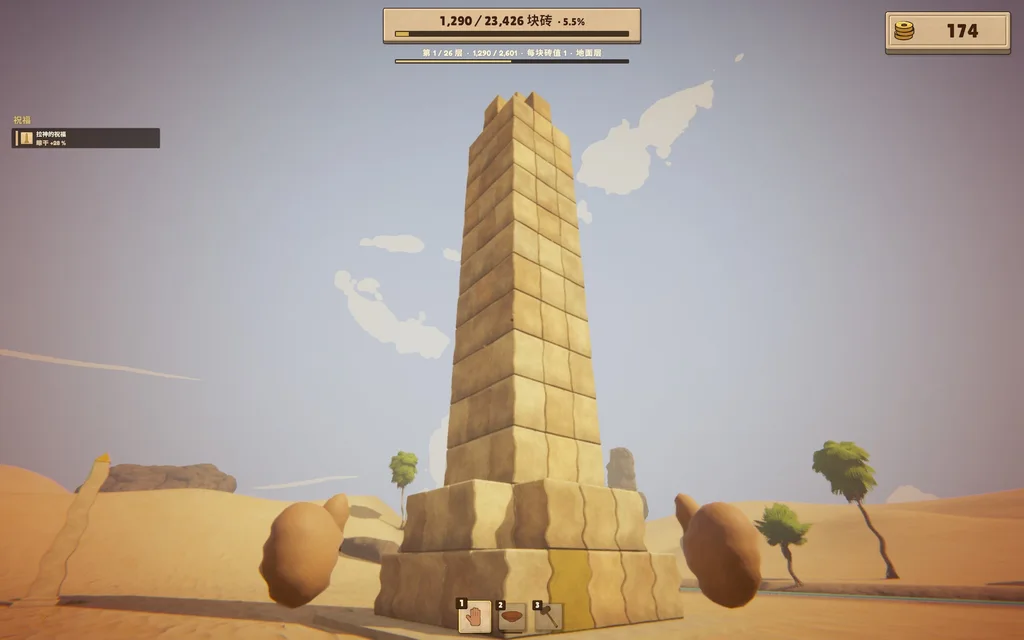
In How They Built the Pyramids, I focus on three things when planning a high-Prestige pyramid: golden bricks, scoring multipliers, and a factory that can keep up with construction. This guide covers the production ratios, machine upgrades, Shabti assignments, monuments, and build order used to plan a Grand Pyramid with Golden Skin.
Prestige and Factory Guide
I use the figures from two completed two-player runs as the reference: a Classic Pyramid with 21.1 million Prestige in 9 hours 30 minutes, and a Grand Pyramid with about 168 million Prestige in 11 hours 26 minutes, including Golden Skin. The figures apply to version 0.42.1. Some values were measured during those runs; the others come from the game data and can change after updates.
How Prestige Scoring Works
I calculate Prestige by taking the raw points from the pyramid and applying every multiplier earned at completion. Since a golden brick is worth 30 times as much as a plain brick, I prioritize gold on the outside and then protect the bonuses that multiply the final result.
Brick Values, Carvings, and Frieze Points
| Raw points | Value |
|---|---|
| Plain brick | 10 |
| Polished brick | 25 |
| Glazed brick | 60 |
| Golden brick | 300 |
| Carving on a brick | 3 × quality (about 290 at quality 97) |
| Outer ring brick, polished / glazed / golden | 15 / 45 / 160, plus 500 per finished ring |
| Carved outer ring brick | 120, or 180 with a frieze pattern |
| Frieze Master | 250 per brick of the longest unbroken frieze run |
| Gilded Cap (golden capstone) | 7,500 |
A pattern made with the Printing Press counts as a frieze; a free-hand drawing does not. That means I can earn 180 raw points from each press-carved outer-ring brick. Frieze Master rewards the longest uninterrupted carved sequence on a single layer with another 250 points per brick. On a Grand Pyramid, a complete first-layer outer ring is worth 84,000 Frieze Master points.
Prestige Multipliers and Their Requirements
| Multiplier | Condition | Points | Factor |
|---|---|---|---|
| Golden Skin | every outside brick is gold | 100,000 | ×2.0 |
| Time | see table below | 0 | up to ×1.5 |
| Golden Tip | top 5 layers solid gold | 40,000 | ×1.15 |
| Hand-Made | at least 90% placed by hand or trolley | 0 | ×1.15 |
| Mirror Finish | no plain brick on the outside | 40,000 | ×1.1 |
For Golden Skin, the outside includes the outer ring of every layer and the capstone. Hand-Made includes bricks placed directly by players or using trolleys. Conveyor belts can transport bricks without reducing the bonus, but placements made by Shabti, trebuchets, or pigeons must stay at 10% or less of the pyramid.
The other workforce bonuses replace Hand-Made instead of stacking with it: trebuchets at 25% give ×1.10, Shabti at 70% give ×1.05, and pigeons at 15% give ×1.05. Monuments and prayer do not directly award Prestige.
Time Bonus Limits for Classic and Grand Pyramids
The time bonus depends on how many players are online when the capstone is placed, not how many people helped earlier. I use the following maximum times for each factor:
| Players at crowning | Classic ×1.5 | Classic ×1.25 | Classic ×1.0 | Grand ×1.5 | Grand ×1.25 | Grand ×1.0 |
|---|---|---|---|---|---|---|
| 1 | 8:00 h | 16:00 h | 30:00 h | 36:12 h | 72:23 h | 135:44 h |
| 2 | 5:39 h | 11:19 h | 21:13 h | 25:35 h | 51:11 h | 95:59 h |
| 3 | 4:37 h | 9:14 h | 17:19 h | 20:54 h | 41:48 h | 78:22 h |
| 4 | 4:00 h | 8:00 h | 15:00 h | 18:06 h | 36:12 h | 67:52 h |
If a run exceeds the ×1.0 threshold, the time factor drops to ×0.9. The timer advances only while the world is open. A pyramid crowned with one player online uses the solo time thresholds, even if other players helped build it.
Example: Reaching 168 Million Prestige
The recorded Grand Pyramid earned 38,505,963 raw points. After applying ×1.5 for time, ×2.0 for Golden Skin, ×1.15 for Golden Tip, ×1.15 for Hand-Made, and ×1.1 for Mirror Finish, the final result was 168,049,649 Prestige. Together, those factors make approximately ×4.36. Without Golden Skin, the same raw score and remaining bonuses would have produced half as much Prestige.
Factory Unlocks and Best Production Ratios
For the factory, I work around a simple target: four Crucibles at full heat, three Printing Presses at speed level 3, and around 12 gold chips per second. The rest of the production line has to supply that setup without falling behind.
Machine Unlock Requirements and Costs
Machine unlocks are based on the number of pyramid bricks already placed, and the thresholds are the same in Classic and Grand. Version 0.42.1 allows up to 16 of each factory building.
| Building | Unlocks at | First price | Each further one |
|---|---|---|---|
| Polishing Stone | 300 | 80 | |
| Glaze Kiln | 2,601 | 2,000 | +40% |
| Water Wheel | 3,500 | 1,600 | +10% |
| Pot Bellows | 3,600 | 900 | +25% |
| Sifting Tray | 5,002 | 250 | +25% |
| Gold Crucible | 5,002 | 1,500 | +40% |
| Printing Press | 6,000 | 4,000 | +35% |
| Clay Dredge | 6,000 | 3,000 | +50% |
| Gold Cradle | 9,236 | 2,500 | +40% |
I avoid buying machinery just to resell it later. Selling within 60 seconds refunds the full price; after that, the refund falls to 50%.
Machine Output and Production Speed
| Machine | Output | Notes |
|---|---|---|
| Sifting Tray with one Shabti | 80 to 100 g of clay per second, 0.3 to 0.4 chips per second | 4 chips per kg. A player with good rhythm reaches about 0.6 |
| Gold Cradle, no upgrades | 100 g per second, 0.3 chips per second | 3 chips per kg |
| Gold Cradle, speed 4, luck 3, golden Temple | about 1,100 g per second, 4.3 chips per second | 3.8 chips per kg. Uses over 4 t of clay per hour |
| Crucible, Shabti stoking | about 640 golden bricks per hour (measured) | Shabti heat stops at 75% |
| Crucible at 100% heat | 1,200 golden bricks per hour | Melts 3 chips per second. No upgrade raises this |
| Printing Press at 32 rpm, speed 1 / 2 / 3 | 720 / about 1,080 / 1,585 carvings per hour | More than 32 rpm adds nothing |
The key difference for a Gold Crucible is heat. A Shabti tending the fire reaches only 75%, while a fully heated Crucible can produce 1,200 golden bricks per hour. A Printing Press also stops gaining speed beyond 32 rpm, so pushing it past that point does not increase output.
Gold Chips Required for Each Golden Brick
| Brick fed into the crucible | Normal heat | White-hot (85% and above) |
|---|---|---|
| Plain | 20 | 15 |
| Polished | 16 | 12 |
| Glazed | 12 | 9 |
I feed glazed bricks into the Crucible whenever possible and keep the heat at 85% or higher. At white-hot temperature, each glazed brick needs only nine chips rather than twelve. Pot Bellows can reach 100% heat without a Shabti in version 0.42.1.
Best Crucible and Printing Press Ratio
These are the required input and press ratios for a single Crucible running at 100% heat:
| It needs | Amount |
|---|---|
| Gold chips | 3 per second |
| Cradle output shown in game | 790 g per second at luck 3, 1,000 g per second at luck 1 |
| Presses at speed 1 | 1.7 |
| Presses at speed 2 | 1.1 |
| Presses at speed 3 | 0.76, so 4 crucibles to 3 presses |
| Sifting Trays with Shabti (before cradles) | 8 to 10, so all 16 trays feed about two crucibles |
With presses upgraded to speed level 3, three presses are enough for roughly four full-speed Crucibles. Before Gold Cradles unlock, even all 16 Shabti-operated Sifting Trays can supply only about two Crucibles.
Factory Upgrades Worth Buying
| Building | Upgrade | Total cost |
|---|---|---|
| Printing Press | speed to level 3 | 10,500 |
| Printing Press | plate, lowest carving quality 85 to 95 | 8,000 |
| Gold Cradle | speed to level 4 and luck to level 3 | 33,500 |
| Pot Bellows | draught to level 3 | 5,200 |
| Crucible | pouring and pot to level 3 | 8,800 |
With 16 Crucibles and 16 Printing Presses, the recorded setup produced approximately 19,200 carved golden bricks per hour. At that point, Crucible throughput is the limiting factor.
Glaze, Clay, and Gold Supply Chain
| Machine | Output | Notes |
|---|---|---|
| Glaze Kiln as bought | 1,200 glazed bricks per hour | 3 s per brick. Feeds exactly one crucible |
| Glaze Kiln, speed level 4 | 4,000 per hour | 0.9 s per brick. The three upgrades cost 29,000 |
| Glaze Kiln, speed level 4, golden Temple | about 15,000 per hour | Feeds 12 crucibles. A shaft at 32 rpm doubles it |
| Clay Dredge as bought | 1,200 g of clay per second | At a 16 rpm shaft or with one average Shabti. Digs nothing without a drive. Feeds one fully upgraded cradle |
| Clay Dredge, output level 4, 32 rpm | 7,200 g per second | Feeds six fully upgraded cradles. The three upgrades cost 36,000 |
| Mud Wheel | 250 g per second as bought, 1,375 at output level 5 | Too little for cradles |
I check the clay supply before expanding the Gold Cradle line. A fully upgraded Cradle needs substantial input, while a Clay Dredge can be expanded to provide much more clay when it has enough power. A speed-level-4 Glaze Kiln with a golden Temple can also supply far more than an unupgraded kiln.
Power Sources, RPM, and Stress
Power sources provide a fixed Stress capacity, while machines draw Stress according to their rpm. Raising a shaft line with Speed Cogs does not add Stress capacity, so a network with too much demand continues operating at a lower speed.
| Source | Speed | Stress it carries |
|---|---|---|
| Water Wheel | 8 rpm | 256, about 320 with one tending Shabti, about 360 with two |
| Treadwheel with one average Shabti | 16 rpm | 320 |
| Hand Crank with one average Shabti | 8 rpm | 64 |
A Printing Press uses 12 Stress per rpm, or 384 at 32 rpm, and stops below 8 rpm. Pot Bellows use 4 Stress per rpm and stop below 4 rpm. Clay Dredges use 10 per rpm, Gold Cradles use 6, and Glaze Kilns use 4.
Two Printing Presses at 32 rpm require three Water Wheels. All 16 Water Wheels can supply ten presses at 32 rpm, or 16 presses at around 21 rpm. To operate 16 presses faster, I assign Shabti to the wheels or add Treadwheels.
Coins Earned When Placing Bricks
Placing a brick earns coins based on the value of the current pyramid layer. The base factors are ×1 for plain, ×2 for polished, ×5 for glazed, and ×30 for golden bricks. A carving and the Sphinx can multiply those earnings further.
Shabti Jobs, Prayer, and Monument Bonuses
I assign Shabti according to the attributes a job actually uses: Strength, Speed, Stamina, and Skill. For example, tending a Water Wheel depends on 70% Speed and 30% Skill; a Shabti assigned there adds about 25% to the wheel output.
Best Shabti Attributes for Each Job
| Job | Strength | Speed | Stamina | Skill |
|---|---|---|---|---|
| Praying | 0 | 0 | 40% | 60% |
| Rocking a cradle | 70% | 0 | 30% | 0 |
| Sifting | 70% | 0 | 0 | 30% |
| Stoking a glaze kiln | 20% | 0 | 20% | 60% |
| Blowing at a crucible | 0 | 0 | 70% | 30% |
| Polishing | 30% | 0 | 0 | 70% |
| Cranking (hand crank) | 70% | 0 | 30% | 0 |
| Hauling and mud carrying | 50% | 50% | 0 | 0 |
| Running (treadwheel, mud wheel) | 0 | 70% | 30% | 0 |
The Scarab-kissed trait increases chips found at Sifting Trays and Gold Cradles by 20%. If two Shabti work a Cradle, both need that trait to receive the full bonus.
How Prayer Improves Production
A completed monument begins with two prayer seats, and upgrades can bring that total to four. Praying Shabti can raise a blessing by up to 40%, but additional worshippers have diminishing contributions: the second counts for 60%, the third for 40%, and the fourth for 30%. Four average level-10 Shabti provide roughly +23%.
I prioritize prayer at a golden Temple while gold chips are limiting production. The full 40% prayer bonus raises its refining factor from ×3.8 to ×4.9, increasing output from each Gold Cradle and Glaze Kiln by about 29%. At a golden Sphinx, the same prayer bonus raises the coin factor from ×2.7 to ×3.3. I move high-Skill, high-Stamina Shabti to the Sphinx only when I need more coins.
A plain monument benefits much less: even the full prayer bonus adds at most ten percentage points, which does not justify assigning four Shabti there.
Monument Materials and Golden Bonuses
Monument blessings scale with the material used to build them: plain ×1.0, polished ×1.35, glazed ×2.4, and golden ×11.15. One golden monument therefore provides more than eleven times the blessing of a plain version.
| Monument | Bricks | Blessing | Plain | Golden |
|---|---|---|---|---|
| Obelisk | 151 | drying speed | +25% | +279% |
| Anubis | 228 | walking and climbing speed | +12% | +134% |
| Temple | 407 | polishing, glaze kiln, cradle, crucible pouring | +25% | +279% |
| Sphinx | 460 | coins per pyramid brick | +15% | +167% |
| Colossus | 755 | bricks carried per stack | +3 | +33 |
The golden Sphinx, available at 6,000 bricks, and the golden Temple provide the most important economic advantages for this setup. The Temple does not make Sifting Trays faster or accelerate melting inside a Crucible. Replacing a monument with a golden one requires demolishing it and paying for its construction again.
Grand Pyramid Build Order for Golden Skin
The Grand Pyramid has 43 layers and 105,995 brick positions, supports up to 16 players, and has a separate leaderboard. The first layer alone contains 7,225 positions, but only 336 are on its outside. This allows me to place 5,002 inner bricks and unlock the Crucible without committing any exterior bricks before gold production starts.
Step-by-Step Golden Skin Build Order
- 0 to 5,002 bricks: I fill only the interior of layer 1, leaving the outer ring empty. I begin using glazed bricks once the Glaze Kiln is available, but I do not pause construction to wait for glaze. The next layer becomes available when the current one is complete.
- At 5,002 bricks: I unlock the Gold Crucible, add Pot Bellows, and run Sifting Trays with Shabti. I keep the Glaze Kiln operating because the Crucible needs glazed input. Two Crucibles are sufficient until Gold Cradles become available.
- At 6,000 bricks: I unlock the Printing Press, then construct a golden Sphinx. Newly placed bricks earn roughly 2.7 times the coins after that.
- Complete the first outer ring: I place only press-carved golden bricks on the outside of layer 1. I reserve golden bricks without carvings for the interior.
- Before 9,236 bricks: I build the Temple out of gold so that Gold Cradles can later benefit from almost fourfold refining speed.
- At 9,236 bricks: I unlock Gold Cradles, add Pot Bellows to each Crucible, and raise the Printing Presses to speed level 3. When brick placement outpaces supply, I scale Crucibles and presses at a 4:3 ratio and keep an eye on clay production.
- Improve placement: I add golden Anubis and Colossus monuments for movement and carrying capacity, then use a belt to move bricks up the pyramid.
- Before placing the capstone: I check that every exterior brick is golden and carved, the top five layers are solid gold, the capstone is golden, and no carved bricks remain on belts or in storage.
Recorded Two-Player Build Milestones
| Milestone in our run (2 players) | Play time |
|---|---|
| 5,002 bricks, crucible | 2:32 h |
| 9,236 bricks, cradles | 5:07 h |
| 13 presses, about 9,000 bricks per hour | 6:40 h |
| Half of all bricks | 8:32 h |
| Capstone | 11:26 h |
Beginning around hour seven, the two-player run reached 15,000 to 23,000 hand-placed golden bricks per hour. The Grand Pyramid was crowned at 11 hours 26 minutes.
Mistakes That Slow Down the Build
- Repeatedly selling and replacing machines: after the first 60 seconds, I recover only half the purchase cost.
- Adding Crucibles too early: without enough gold chips, extra Crucibles cannot contribute much before Gold Cradles unlock.
- Keeping Printing Presses at speed level 1: in the recorded run, seven unupgraded presses held the entire factory to roughly 4,850 bricks per hour.
- Using a Shabti on a Crucible that already has Pot Bellows: Shabti heating contributes nothing above 75% heat.
I would not use this same Golden Skin plan on a Classic Pyramid. Its first two layers contain exactly 5,002 bricks, including 392 outside bricks that must be placed before the Gold Crucible unlocks. That makes Golden Skin practically unattainable there.
Carving Limits, Chisel Costs, and Other Scoring Details
Printing Press Carving Limits
A world can retain up to 20,000 press-made carvings and 600 hand-drawn carvings. Once the press limit is reached, a newly carved brick removes the oldest carving buried inside the pyramid. Carvings that remain visible on the exterior, including the outside rings, are never removed this way.
Carved bricks left in crates or on belts also count toward the limit, so I place them before crowning. The recorded Grand Pyramid contained 99,615 golden bricks, but its final report listed only 19,097 carvings. Interior carvings survive mainly among approximately the last 12,800 interior bricks; the outside should take priority for frieze scoring.
Chisel Removal Fees
The Chisel can remove only exterior bricks. The first removal costs 250 coins, and each subsequent removal increases the fee by 6% in version 0.42.1, down from 20% in earlier versions. Around 15 replacements cost approximately 5,800 coins, while 100 can cost around 1.4 million. Every removed brick must be replaced before the pyramid can be completed.
Golden Brick Event
Once 200 bricks have been placed, a golden brick event occurs every 150 to 300 seconds. Whoever collects it within 90 seconds receives 30 times the coins of a brick on the current layer. If nobody picks it up in time, it becomes a normal brick.
Awards and Their Prestige Values
Each award goes to the player with the highest qualifying result. Together, all awards add only 15,001 raw points, so I do not base a leaderboard strategy around them.
| Award | For | Raw points |
|---|---|---|
| Chief Architect | most bricks placed by hand | 2,500 |
| Midas | most golden bricks placed | 2,500 |
| The Scribe | best single carving on the pyramid | 2,000 |
| Mudslinger | most clay scooped, at least 1 kg | 1,500 |
| Middle Manager | most Shabti hired | 1,500 |
| Trebuchet Enthusiast | most volleys fired | 1,500 |
| Best Çaycı | most glasses of tea served | 1,500 |
| Bazaar Tycoon | most coins earned | 1,000 |
| Trolley Captain | most bricks wheeled into the walls, at least 50 | 1,000 |
| Professional Napper | fewest bricks placed | 1 |
In the recorded run, a trebuchet volley placed 97 bricks, but the Trebuchet Enthusiast award was not awarded for that volley.