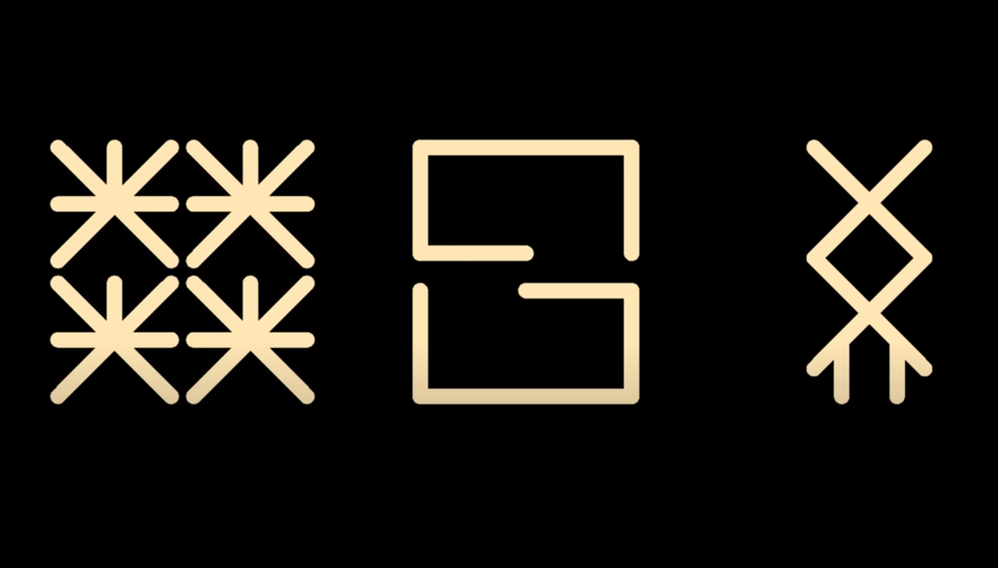
In Message From Aliens, I work through an alien-language textbook by interpreting symbols, building a dictionary, and solving problems. This walkthrough follows the game from the basic controls through Chapter 1 and Chapter 2, with explanations and puzzle answers in textbook order.
Walkthrough: Chapter 1 and 2 Answers
I start with the controls, then go through each text and problem in the first two chapters. Chapter 1 focuses on arithmetic, while Chapter 2 moves into geometry. I keep the important symbol clues and answers together so I can follow the textbook without losing my place.
Table of Contents:
How to Play Message From Aliens
Basic Controls
These are the controls I use when I first open the game:
- The left side of the screen shows pop-up-style messages. I can ignore them at first.
- I move between screens by clicking the underlined text on the right side.
- I click the question mark below a character to write a note about it.
- The button in the upper-right corner ends the game on the home screen and acts as Back on other screens.
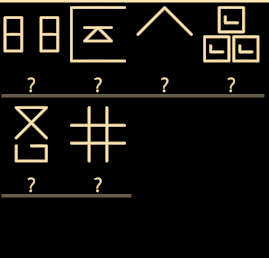
Textbook and Options
At the beginning, I only have two menu items: Textbook and Options.
I can change the screen size through the options shown below. At this stage, I am happy to try the available choices until I understand what they do.
Most of my progress comes from deciphering the Textbook, so that is where I focus next.
Chapter 1 Walkthrough – First Half
Getting Started: Problem 1
Some entries are blank when I start Chapter 1. The first entry is a Problem page. On these pages, I fill the outlined boxes by assigning characters to them.
For the first problem, I choose one of the symbols |, ||, or ||| from the top and place it in the box below. A change on the screen tells me that my choice is correct. I do not need to understand the sentence yet; testing the options works.
Problem 1 answer: ||. The instruction is essentially asking me to write an arithmetic sequence with a common difference of 1.
How I Read the Alien Dictionary
A Text page works differently. When I click a character in the passage, a dictionary entry opens on the left. The entry presents the part of speech, the radical, and a definition separated by a blank line. I use the passage and these clues to assign possible meanings to the characters.
Texts 1-5 and Problems 2-3
- Text 1 – Addition: I treat this passage as an introduction to addition. I watch carefully because both = and ≠ appear.
- Text 2 – Subtraction: This passage introduces subtraction. I make sure not to confuse the operation subtract with the idea of a negative value.
- Problem 2: The two equations are ? − 2 = 3 and ? + 2 = 3. My answers are 5 and 1.
- Text 3 – Multiplication: This is where I notice that numbers from 8 onward look unusual. The aliens use a modified base-7 notation. For example, the source writes 6 + 5 = 74, using 7 and 4 to express 11. There is no single character for 8, just as there is no single Japanese character representing 11.
- From this point on, some passages cover more than one page. I use the page-turn button shown below to read every page rather than stopping at the first screen.
- Text 4 – Division: I identify division as the topic.
- Text 5 – Remainders: This passage introduces remainders.
Problem 3: The question is 26 ÷ 3 = ?? remainder ?. The supplied answer is written as 71 (8) and 2.
Texts 6-11: Variables, Fractions, and Order
I turn the textbook page before continuing.
- Text 6 – Variables: I encounter variables and expressions such as if … then. I keep these in my notes for later.
- Text 7 – Fractions: This passage introduces fractions. In this world, the denominators are powers of 7. I also find words meaning integer and non-integer.
- Text 8 – Comparisons: Symbols with horizontal bars above and below appear to compare two things, like = and ≠. The second page uses somewhat vague alien phrasing, but I can identify ideas such as larger, smaller, and more/very.
- Text 9 – Repeating Decimals: This is one of the hardest passages for me. The number system does not suddenly switch to base 6 for decimals. In base 7, 1/2 = 0.333…, so the figure-eight-shaped symbol indicates repetition.
- Problem 4: The expression is 1.?… = 2. I enter 6. This follows the same idea as 1.999… = 2 in decimal notation.
- Text 10 – Order: I learn concepts such as inside, is, nth, number, previous, and next. These will remain useful.
- Problem 5: If X comes after Y and before Z, the missing positions are X, Z, Y, in that order.
- Text 11 – Maximum and Minimum: I use the shapes of the characters to connect these ideas with larger and smaller. Understanding the final sentence helps with later passages, so I try to form a hypothesis about it.
Page 3: Texts 12-18 and Problem 6
- Text 12 – True and False: I interpret these as truth values, or as yes and no/not.
- Text 13 – Logical AND and OR: The passage introduces the equivalents of and and or.
- Problem 6: The four statements ask whether the opposite of yes is no, the opposite of no is yes, the opposite of < is >, and the opposite of > is <. I answer is, is, is not, is not. The character meaning is not first appears here, so I judge it from its shape. The negation of > is ≤, not simply <.
- Text 14 – Numbers and Numerals: I distinguish a number from a numeral. A standalone character for character also appears here for the first time.
- Text 15 – Sets and Things: This passage introduces sets and objects. The second page is difficult at this stage, so I return to it later. The symbol 日 means thing, and H means quantity. I also encounter connect and element. These abstract words are important later.
- Text 16 – Inside and Not Inside: I use these translations rather than simply contains, because they fit later passages better. The opposite of the inside term from Text 10 appears here.
- Text 17 – Singular and Plural: I learn the ideas of one, multiple, and pair.
- Text 18 – All and Some: I identify terms such as all/every, some, not included, and something other than/different from. The vocabulary is already getting pretty abstract, even though I am still in Chapter 1.
Chapter 1 Walkthrough – Second Half
Page 4: Set Problems, Powers, and Logarithms
- Problem 7: Given the set {1, 2, 3, 4, 5, 6, 7}, I find how many values are greater than 3, how many are less than 3, the maximum, and the minimum. The answers are 4, 2, 7, 1. This puts several ideas from earlier texts together.
- Problem 8: The first set is {2, 4, 6} and the second is {3, 6}. I identify the value in both sets, the two values only in the first set, and the value only in the second. The answers are 6, 2, 4, 3.
- Text 19 – Powers: I learn exponentiation, including separate symbols for squared and cubed.
- Text 20 – Logarithms: This text introduces the logarithm, or log.
- Text 21 – Halves: I finally encounter half. It appears here because a power of 0.5 relates to a square root. The text also introduces one third, although cube roots do not appear.
- Problem 9: The equation says ? squared = ? cubed + 1. I enter 3 and 2.
- Problem 10: X, Y, and Z are positive and not equal to 1. If X to the power of Y = Z, the logarithm expression uses Z, X, Y in that order. I can also solve this one by testing the possibilities.
- Text 22 – Base-7 Exponential Notation: I understand this as a way to write × 7^, similar to the E in an Earth-style number such as 2.997E8.
Page 5: Approximations and Calculation Order
- Text 23 – Approximation: I translate the equivalent of ≈ carefully, because it becomes especially important in Chapter 2.
- Problem 11: I complete √2 ≈ 1 + ? and √3 ≈ 1 + ? with 3/7 and 5/7. For example, √2 is about 1.414, close to 1 + 3/7, or 1.428571… .
- Text 24 – From and To: I learn the symbols for from and to. The second character in the alien-language rendering of the game title already provides a clue to one of them.
- Text 25 – For and By: I read these as in order to/for and by means of. Since the alien language follows subject-verb-object order, I keep word order in mind.
- Text 26 – Increase and Decrease: I identify the two opposite changes.
- Text 27 – Calculation Order: I learn left and right, and I discover that the aliens calculate from left to right. Unlike standard Earth arithmetic, multiplication and division do not take priority over addition and subtraction. Symbols such as half, square root, square, and cube still take priority. For can also work like an opening parenthesis.
- Problem 12: I fill 1 ? 2 ? 3 ? 4 = 14 with ÷, +, ×, remembering the aliens’ left-to-right calculation order.
That completes Chapter 1, which covers arithmetic. I unlock automatic number-notation conversion as a reward. Numbers are still going to matter, though, so I continue to the next chapter.
Chapter 2 Walkthrough – First Half
The Guide and the Title-Screen Minigame
There is an extra feature I check before working through the new texts. The button at the upper right, between Page Forward and Back, opens the Guide on the left. Much of it may be unreadable at first, but it is still worth examining.
A minigame is also accessible from the title screen. I do not need it for the main walkthrough, but its play instructions, guide, and rules include words such as right, left, swap, center, and mirror image.
Text 1: Circles and Pi
Chapter 2 begins with a difficult passage. One clue is the ^-shaped character. I read it as of, or more precisely as a marker that turns the preceding word into something adjectival.
When I inspect the passage carefully, I find ≈ 22/7 on the last line. That tells me the symbol at the far left of that line means pi (π). With this clue, I can work backward through the statements:
- The area of a circle is π × radius squared.
- The circumference of a circle is π × radius × 2.
- Area is the quantity of a shape.
- Circumference is the line around the boundary of a shape.
- Length is the quantity of a line.
- A radius is a line from any point on the circle to its center.
- A circle is a shape made from a line connected in a loop.
This reveals the subject of Chapter 2: geometry.
Text 2: Points and Lines
I find terms for infinitesimal, infinite, curve, straight line, starting point, ending point, and parallel. Importantly, the alien word translated as straight line corresponds to a line segment in Earth mathematics.
I also use the dictionary entries to test possible meanings. A word close to connect or link together seems to appear, although I am less certain about that translation.
Problem 1: Circle Circumference and Area
The problem asks for the circumference of a circle with radius 1 and the area of a circle whose circumference is π. I rearrange the formulas and enter × 2 and ÷ 4.
Text 3: Angles and Radians
This text introduces angles, along with expressions built from half + straight line and infinite + straight line. I also find words for angle measure and perpendicular.
The important difference is that the aliens use radians: a full circle is 2π, not 360 degrees.
Text 4: Quadrilaterals
I read this as a lesson on four-sided shapes, or quadrilaterals. The text also introduces regular polygons and a verb meaning flattened or squashed. Combining flattened + regular polygon + four-sided shape gives the term for a rectangle.
Problem 2: Equilateral Triangles
The question explains that a triangle is made from three straight lines joined in a loop and that an equilateral triangle has three equal-length sides. I fill the blanks for its perimeter, angle, and area using × 3, ÷ 3, and ÷ 4. The angle is given in radians, and the area expression includes the side length squared multiplied by √3.
Text 5: Vectors and the Dictionary Shortcut
Here I find vectors and directions such as up, down, left, right, forward, backward, and opposite. Reading through the final page gives me a very useful clue: if I understand the vector characters, I should be able to read the Guide by clicking its button in the upper-right corner.
From the fifth line of the Guide onward, I can begin deciphering the instructions. One line explains how a left click opens the dictionary. The especially useful instruction on line seven concerns right-clicking to open a dictionary entry.
I can use right-clicking in other parts of the game too. That means I can follow dictionary entries from problem text or even from another dictionary definition, going deeper into the language instead of relying only on the current textbook passage.
Problem 3: Inverse Operations
I identify the inverse of addition, multiplication, and exponentiation. The answers are subtraction (−), division (÷), and logarithm.
Chapter 2 Walkthrough – Second Half
Page 2: Three-Dimensional Shapes and Coordinates
- Text 6 – Three-Dimensional Shapes: I find terms for three-dimensional, space, face/surface, and volume. Some compound characters combine angle + point to mean vertex, or shape + thing to describe a solid figure. Later pages explain cubes and rectangular solids.
- Problem 4: The text describes a sphere as a three-dimensional shape and defines its radius as the distance from the center to any point on its surface. The volume expression has the form radius ? × ? × π ÷ ?, while the surface-area expression is radius ? × ? × π. The supplied guide does not give the completed blanks for this problem.
- Text 7 – Cylinders and Cones: I read compounds such as circle + column + thing for cylinder. The individual term for column means pillar, while the cone-related character on its own means pointed. The text also introduces diagonal/slanted.
- Problem 5: I fill in the face counts for regular polyhedra made from equilateral triangles, squares, and regular pentagons. The answers, in order, are 4, 8, 20, 6, 12.
- Text 8 – Right Triangles: I identify right triangles through a phrase combining perpendicular + angle + triangle. This passage discusses the Pythagorean theorem.
- Text 9 – Coordinates: I notice patterns in the radicals. The L-shaped component relates to shapes; combinations involving vectors suggest direction; and the box-shaped □ component suggests place. Thing + place forms position, while place + number forms coordinate.
- Problem 6: I need the distance from vertical coordinate 0 and horizontal coordinate 0 to an unknown pair of integer coordinates. I enter 3, 4, 5, the familiar Pythagorean triple.
- Text 10 – Congruence and Similarity: This passage introduces congruence, similarity, and a symbol for ratio formed from multiplication + quantity. The last two lines may help when I reach physics, so I try to decipher them now.
Page 3: Ellipses and Problem 7
- Text 11 – Ellipses: I understand an ellipse as a flattened circle. It has two foci, a term I will also need in optics. The second page is harder and discusses a parabola (throw + of + trajectory) and a hyperbola (division + curve).
- Problem 7: A ↖-shaped character appears repeatedly in the game. I finally interpret it as this; its shape resembles the mouse cursor.
For an ellipse with major diameter 2 and minor diameter 1, the question asks for the distance from the center to a focus. The source gives the answer using 3 and a square-root symbol. This is a difficult formula-based problem.
After Chapter 2, I unlock the Incremental minigame and Chapter 3. I also unlock page bookmarks: a Mark button appears near the page-turn control, letting me mark texts and problems and jump to those pages from the title screen.
The calculations become harder from here, but I have already worked through one of the biggest obstacles: the beginning of Chapter 2.